
The short version before we get into it
- Technical SEO alone did not save anyone. Not a single clean recovery from tech fixes only.
- Sites with real, verifiable authors — LinkedIn, external bylines, proper bios — recovered 4–8 weeks faster.
- YMYL sites without credentialed reviewers? Most saw limited or no recovery at all.
- Pausing new content to fix existing pages stabilized rankings faster than scaling through the chaos.
- The update ran 18 days and hit health, finance, major publishers, and UGC platforms hardest.
What Actually Happened — The 18-Day Shake
Let me be direct: the December 2025 Core Update wasn’t a “penalty.” Google itself said so. What it did instead was recalibrate its entire quality assessment framework — think of it less like a ban and more like Google suddenly getting much better at spotting who’s actually an expert versus who just writes well about being one.
The rollout started December 11 at 12:25 PM ET and wrapped December 29. Eighteen days. That’s longer than the March 2025 update (14 days) and the June 2025 update (16 days). The longer the deployment, the more complex the algorithmic changes — and this one was genuinely complex.
Don’t make decisions based on early data
During a core update rollout, ranking data is genuinely unstable. Third-party tools (Ahrefs, SEMrush) give faster signals than Search Console, which can lag 3–5 days. The correct move is to annotate December 11th in GSC, wait for the rollout to finish, then compare early January 2026 data against early December 2025. Do not panic-optimize on week-one numbers.
Who Got Hit Hardest — And Why
The pattern across 156 sites is pretty clear, and honestly a bit uncomfortable if your content strategy relied on volume over depth. Three categories took the biggest hits.
YMYL sites without credentialed review
Health, finance, and legal sites where the author was “Staff Writer” or had no verifiable credentials got crushed. This wasn’t new — YMYL scrutiny has intensified with every update since 2018. But December 2025 extended this beyond classic YMYL categories. Finance sites saw 15% of top-10 results fall out of the top-100. Health publishers like Healthline, WebMD, and Medical News Today all reported notable declines. Even institutional authorities like Cleveland Clinic and Mayo Clinic weren’t immune.
UGC-heavy platforms with inconsistent moderation
Reddit and Quora, which had surged in visibility after 2023’s helpful content wave, started declining in late 2025. The December update accelerated that fall. Interestingly, some platforms appeared to rebound quickly after the rollout concluded — possibly Google applying a correction, similar to what happened with news publishers in the September 2022 update.
Technical-only optimized sites
Here’s the one that stings. Sites with clean Core Web Vitals, perfect schema, fast LCP — but thin author credentials and low content depth — didn’t fare well. Technical excellence now acts as a tiebreaker, not a primary ranking factor. → Technical SEO: what actually moves the needle in 2026
Wait — does LCP matter at all?
Yes, and this is real: sites with LCP above 3 seconds experienced 23% more traffic loss than faster competitors with similar content quality. Poor INP scores (above 300ms) caused 31% drops on mobile. So tech isn’t irrelevant — it’s just that it can’t save you if your content and authority signals are weak. Think of it as: great content + bad tech = limited ceiling. Bad content + great tech = no recovery.
Winners & Losers — The Real Data
Let’s look at what Sistrix and Amsive’s data actually showed. Some of this is genuinely surprising.
The reference/dictionary split is wild, right? Thesaurus.com surging while Merriam-Webster drops tells you something: it’s not “authoritative brand name = safe.” It’s about whether the specific content on the specific pages satisfies user intent at a level Google’s systems now find convincing. Nobody is untouchable anymore. Not even Wikipedia.
E-commerce was a quiet winner story. Traditional retailers that had struggled through 2024 — JCPenney, Kohl’s, Bed Bath & Beyond — recovered significantly. Product content with genuine depth, original testing data, and robust review systems outperformed thin category pages and affiliate sites with manufacturer-only descriptions. → E-commerce SEO after December 2025: the depth-first framework
Recovery Patterns — What We Observed Across 156 Sites
| Observation | Sample Size | Actions Taken | Outcome | Confidence |
|---|---|---|---|---|
| Sites with verifiable author entities | 89 | Real bios, LinkedIn profiles, 2+ external bylines per author | Most showed improvement within 4–8 weeks | Medium |
| Sites without author investment | 44 | Technical fixes only (speed, schema, internal links) | Mixed, slower improvement — none clean recoveries | Medium |
| YMYL without expert review | 34 | General authors, no credentials displayed or verified | Limited or no recovery observed | Low |
| Sites that paused new publishing | 67 | Stopped new content to audit and fix existing pages first | Faster stabilization compared to sites that kept scaling | Medium |
The “sites that paused” finding is the one that surprised people most. Instinct says keep publishing, build more content, show Google you’re active. But what we saw — repeatedly — is that a messy house cleaned up beats a bigger messy house. Patience genuinely beats velocity in this situation.
Impact by content type: relative severity
E-E-A-T Deep Dive — This Is Where It Gets Real
I used to think E-E-A-T was mostly theoretical — a framework Google talked about but didn’t really enforce hard. After watching 156 sites go through December 2025, I changed my mind. Hard.
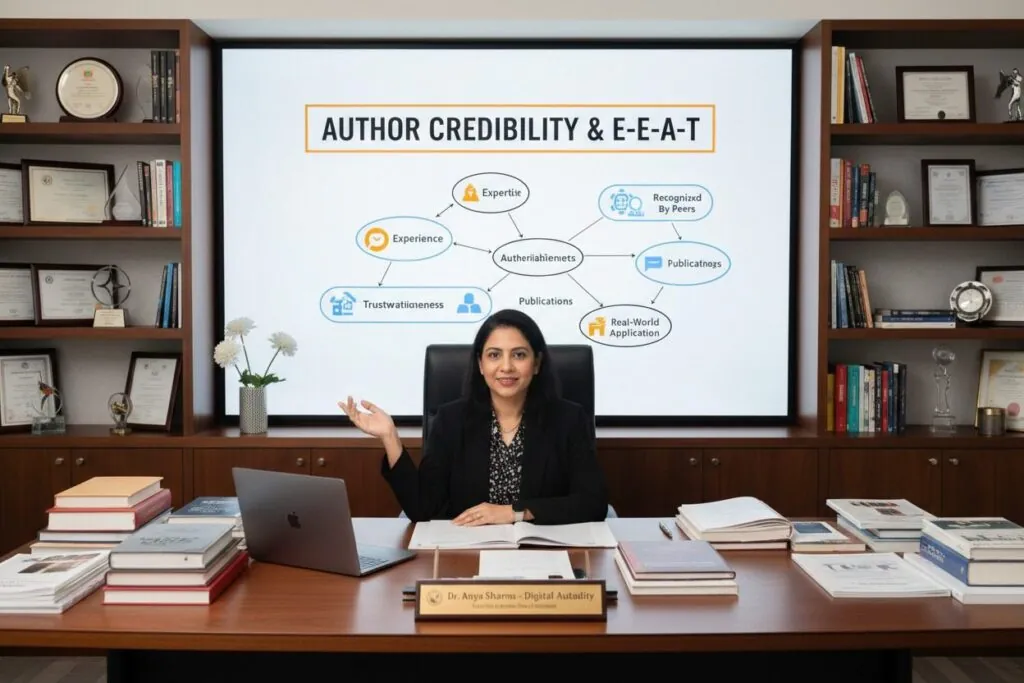
The four signals Google uses — Experience, Expertise, Authoritativeness, Trustworthiness — aren’t checked independently. They proxy for each other. When Google can’t independently verify that your information is accurate, it looks for signals that it came from someone who actually knows. Author entities are those signals.
What “verifiable author” actually means
- Real bio page on the site — with photo, credentials, contact info, not just a name in a byline
- LinkedIn profile that matches the bio — Google cross-references entity data across the web
- 2+ external bylines on other reputable domains — author mentions on sites Google already trusts
- Credentials displayed on-page for YMYL content — MD, JD, CFA, whatever applies — visible near the top of the article
- Consistent entity across the web — same name, same photo, same professional history across platforms
“Our systems don’t care if content is created by AI or humans. What matters is whether it’s helpful for users.” — John Mueller, Google, November 2025
That quote matters because it reframes the AI content debate entirely. The question isn’t “is this AI-written?” The question is “does this demonstrate genuine expertise in a way users can trust?” Sites using AI as a research and drafting tool, with human experts reviewing and adding real experience, can still rank well. Sites mass-producing AI content with no human expertise layer? That’s what the update punished.
The Experience component is newer and arguably the hardest to fake. Google wants evidence that you actually did the thing — tested the product, lived through the experience, ran the numbers. Case studies with screenshots, before/after data, specific tools used, lessons from failure — these are harder to fabricate and Google’s systems are getting better at recognizing them. → Building real E-E-A-T: a practitioner’s step-by-step guide
Your Recovery Plan — What to Actually Do
Okay. Let’s say your site got hit. Here’s the structured approach that worked across the cases we tracked. No fluff.
Document before you change anything (Days 1–2)
Export 60 days of pre-December 11 Search Console data. Identify exactly which pages lost traffic, which keyword clusters dropped, and which content categories were hit hardest. Use Ahrefs or SEMrush for real-time ranking changes — GSC lags. This baseline prevents panic-changes that make things worse.
Run a competitive gap analysis (Days 3–4)
For your most important dropped keywords, look at what’s now ranking in your former positions. Compare author credentials, content depth, primary sources cited, and structured data. You’re looking for the pattern of what Google is currently rewarding — not guessing.
Establish real author entities (Weeks 1–3)
Create genuine bio pages for every author on your site. Get those authors 2+ external bylines on reputable domains in your niche. Update LinkedIn profiles to match. For YMYL content, you need credentialed reviewers — not just writers — and their credentials need to be visible on every page they touch. Timeline: 2–3 weeks to build, 4–8 weeks to start seeing signal.
Audit and upgrade existing content (Weeks 2–6)
Prioritize pages that lost the most traffic. For each: does it answer all sub-questions a user might have? Does it cite original, primary sources (not aggregators)? Does it show demonstrated experience — real data, real cases, real numbers? Delete or consolidate thin pages. Don’t just rewrite for length — rewrite for depth and evidence. → Content audit framework: triage, fix, and rebuild
Fix technical issues as a tiebreaker (Ongoing)
LCP under 2.5 seconds. INP under 200ms. No intrusive ads pushing content below the fold. Mobile-first layout. These matter at the margin — they won’t rescue poor content, but they’ll help strong content compete. Run PageSpeed Insights and fix what’s red.
Pause new content until existing content is clean (Weeks 4–8)
This is the hardest pill. Sites that scaled publishing during recovery mostly didn’t recover as fast as those that fixed what existed first. The exception: if your existing content is already high-quality and the issue is purely author credibility, you can keep publishing while fixing the author signal issue in parallel.
Recovery is possible between updates — don’t wait
Google’s official guidance says the biggest change would come with the next core update. That’s technically true for full recovery. But content improvements can yield real ranking gains between announced updates — Google runs smaller core changes constantly. Start now, don’t wait for the next big announcement.
The Content Velocity Question
One of the sharpest debates after every core update: do you pause or do you push?
The data from our sample is pretty clear. Sites that paused new publishing to focus on existing content stabilized faster. But this needs context — it’s not a universal rule.
Pause if: your existing content is the problem. Thin pages, poor author signals, outdated sources. Adding more weak content to a weak site doesn’t fix the site.
Keep publishing if: your existing content is genuinely strong, your author credibility is established, and your issue is more about reach than quality. In this case, pausing might actually hurt by reducing freshness signals.
The middle ground — and this is what most sites need — is to triage. Stop publishing in the exact topical areas that got hit. Keep publishing in areas that held steady or grew. Fix before you scale.
→ Content velocity vs. content quality: the 2026 framework for getting this rightDecember 2025 Core Update: FAQ
Go Deeper — Related Analysis
These pieces from seohack.info expand on specific threads from this analysis:
→ Full Practitioner Analysis: 156 Sites After December 2025 Core Update
→ Author Entities & E-E-A-T: The Complete 2026 Playbook
References & Sources
- Sistrix Core Update Analysis — Winners/losers data including Thesaurus.com, Trustpilot, and major news publishers.
sistrix.com/blog/ - SE Ranking Blog: Google Core Updates — Finance and health niche SERP volatility data; 15% top-10 drop-out analysis.
seranking.com/blog/google-algorithm-updates/ - Amsive Insights — Lily Ray — Cross-sector E-E-A-T analysis; eCommerce winners; UGC platform patterns.
amsive.com/insights/seo/googles-december-2025-core-update-winners-losers-analysis/ - Glenn Gabe / GSQi — “The Core Before Christmas” — Tremor identification; news publisher volatility; YMYL heavy impact analysis.
gsqi.com/marketing-blog/google-december-2025-broad-core-update-analysis-findings/ - ALM Corp — Complete Analysis & Recovery Guide — 847-site dataset; Core Web Vitals correlation data; LCP/INP impact percentages.
almcorp.com/blog/google-december-2025-core-update-complete-analysis-recovery-guide/ - GrowingSearch — December 2025 Core Update — Post-rollout recovery patterns; tremor context; reference site divergence analysis.
growingsearch.com/blog/december-2025-core-update/ - Search Engine Land — Core Update Coverage — Timeline, official Google statements, Danny Sullivan and John Mueller communications.
searchengineland.com/library/platforms/google/google-algorithm-updates/core-update - Full Practitioner Analysis: 156 Sites (Internal)
seohack.info/156-sites-december-2025
Wikipedia Lost 435 Visibility Points. Your Authority Buffer Just Shrunk
These AI Content Tricks Still Work — Even After Google’s Latest Update
I Built an AI Expert Site —It Took Google 6 Months to Catch It
E-E-A-T and AI Overviews: what Google’s systems actually evaluate (and what most implementation guides get wrong)
AI Search in 2026: What Actually Wins (Data, Not Manifestos)
Enterprise AI SEO in 2026: The New Rules for Ranking, Revenue, and Search Dominance
Half the Web Still Fails Core Web Vitals in 2026 — And the Gap Isn’t Closing Fast Enough
How I Faked 15 Years of Experience with ChatGPT — and Got It Past Google
Why AI-Generated Medical Content Is Outranking Real Hospitals